
The right SAP Business One hosting provider gives a partner more than infrastructure. It provides a secure, resilient and supportable platform that protects the customer relationship, reduces technical workload and can scale commercially. The best choice combines SAP Business One expertise, transparent service levels, tested recovery processes and a partner-first operating model.
For an SAP Business One partner, hosting is not a background purchasing decision. The infrastructure sits beneath the service you sell, the experience your customers receive and the reputation your team has built. A slow system, an unclear escalation path or an untested restore process will be experienced by the customer as a partner failure, regardless of which supplier owns the underlying platform.
That is why a generic cloud comparison is not enough. Partners need to evaluate how a provider designs, operates and supports SAP Business One workloads, how responsibilities are divided, and whether the commercial model supports profitable growth. The right provider should strengthen the partner’s proposition without inserting itself between the partner and the customer.
What should modern SAP Business One hosting include?
Modern SAP Business One hosting should combine an appropriate architecture, active operational management and clear accountability. Compute and storage are only the foundation. A complete service should address performance, access, security, backup, recovery, monitoring, patch coordination, capacity, escalation and change control.
A platform designed around the database, operating system, add-ons, integrations and user profile of each SAP Business One estate.
Proactive monitoring of availability, capacity and infrastructure health rather than waiting for customers to report degradation.
Layered security controls, including identity protection, restricted administrative access, segmentation, logging and regular review.
Documented backup and disaster-recovery arrangements with agreed recovery objectives and evidence that restoration is tested.
An operational support model that defines who owns each layer, how incidents are prioritised and how the SAP partner remains informed.
A scalable commercial model that allows the partner to add customers and services without rebuilding its internal infrastructure team.
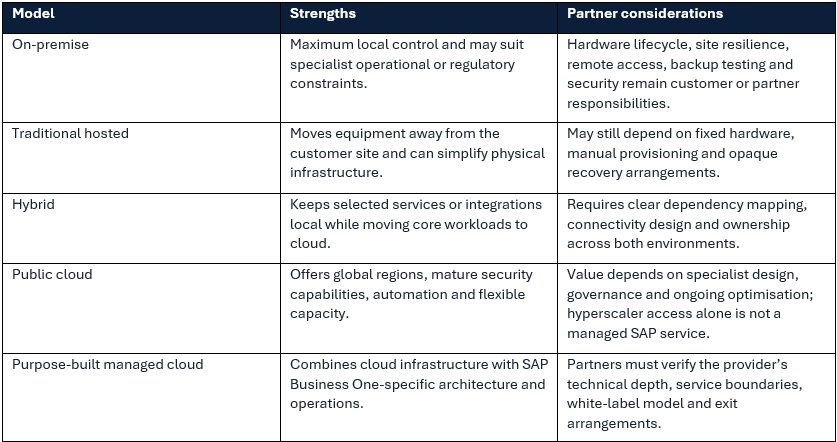
How do on-premise, hosted, hybrid and cloud models compare?
The labels used in the market can be misleading. A server located in someone else’s data centre may be described as cloud even when it lacks elasticity, automation or modern resilience. Partners should assess the operating model behind the label.
 Why does SAP Business One expertise matter?
SAP Business One is not simply another Windows workload. Performance can be affected by database configuration, storage latency, add-ons, integrations, remote access patterns, print services, reporting and background processes. A provider that understands only generic infrastructure may meet a virtual-machine uptime target while users still experience a poor application service.
A specialist provider should be able to discuss SQL Server and SAP HANA deployment patterns, client access, Service Layer and integration dependencies, licensing boundaries, add-on compatibility, maintenance windows and the operational impact of upgrades. It should also know when an issue belongs to infrastructure, the SAP application, an add-on or the customer network, and bring the right teams together quickly rather than passing tickets between suppliers.
What security questions should partners ask?
Security should be evaluated as a shared operating discipline, not a list of product badges. Cloud platforms provide powerful controls, but they still require correct configuration, restricted access and continuous oversight. The hosting provider should be able to explain its controls in practical terms and show where the partner’s responsibilities begin and end.
1. How are privileged accounts created, approved, protected and reviewed?
2. Is multi-factor authentication enforced for administrative access?
3. How are customer environments separated, and what prevents unauthorised movement between them?
4. Which events are logged, monitored and escalated?
5. How are operating-system vulnerabilities, endpoint protection and security updates managed?
6. How are data-location, retention and deletion requirements handled across global regions?
7. What is the incident-response process, and how will the partner communicate with its customer?
Security is a joint responsibility, not solely the responsibility of the hyperscaler. AWS and other cloud providers secure the underlying cloud platform; customers and managed-service providers still have responsibilities for identities, operating systems, applications, data and configuration. A capable provider should make that shared-responsibility model explicit.
How should uptime and resilience be assessed?
An uptime percentage is useful only when its scope is understood. Partners should ask what is measured, which exclusions apply, whether planned maintenance is included, and what service credit or remediation follows a breach. Cloud4Partners currently publishes a 99.995% uptime SLA for its SAP Business One hosting platform on AWS, but partners should still assess the complete service design rather than relying on one number.
Resilience also requires removing single points of failure, protecting dependencies and planning for regional or component-level disruption. High availability and disaster recovery are related but different. High availability is designed to keep services running through common component failures. Disaster recovery restores service after a larger event and requires defined recovery time and recovery point objectives.
What should a backup and disaster-recovery service prove?
A backup is only valuable if it can be restored within the period the business can tolerate. Partners should look beyond statements such as 'daily backups included' and agree what is protected, how often, for how long, where copies are stored and who validates restoration.
RPO: the maximum acceptable amount of data loss measured in time.
RTO: the target time for restoring an agreed service after disruption.
Retention: how long recovery points are retained and whether legal or customer requirements alter that period.
Immutability or isolation: controls that reduce the risk of attackers or administrators deleting every usable copy.
Restore testing: scheduled evidence that systems, databases and dependent services can actually be recovered.
Runbooks: named owners, dependencies, communication steps and decision points for invoking recovery.
Why do monitoring and performance management matter?
Partners need visibility before a customer complains. Monitoring should cover service availability, CPU, memory, storage capacity, disk performance, backup status, security signals and relevant connectivity. Thresholds should be tuned to each environment rather than generating an unmanageable stream of generic alerts.
Performance management is equally important. SAP Business One estates change as databases grow, users increase, integrations are added and reporting becomes more demanding. A mature provider reviews trends, forecasts capacity and recommends changes before user experience deteriorates. This turns infrastructure from a reactive cost into a managed service that supports customer growth.
What should a meaningful SLA contain?
A strong SLA is understandable by both technical and commercial teams. It defines availability, support hours, priority levels, response targets, restoration or workaround expectations, maintenance arrangements, escalation routes, reporting and exclusions. Response time alone is not resolution; the provider should explain how incidents progress and when senior technical resources become involved.
Partners should also examine the operational behaviour behind the document. Ask for sample reports, escalation examples and the cadence of service reviews. A provider that produces transparent evidence and discusses recurring causes is more valuable than one that closes tickets quickly without improving the underlying estate.
How does the hosting model affect partner profitability?
The commercial model should make recurring revenue easier to build and manage. Partners need predictable unit economics, clear inclusions, straightforward provisioning and the ability to scale without repeatedly designing bespoke infrastructure. Hidden charges for backups, monitoring, support or additional databases can damage margin and create awkward conversations with customers.
A channel-only, white-label provider also protects the commercial relationship. Cloud4Partners is designed exclusively for SAP Business One partners and positions itself as an extension of their teams rather than a direct supplier to end customers. That distinction matters: the partner should retain ownership of the account, proposition and customer success plan.
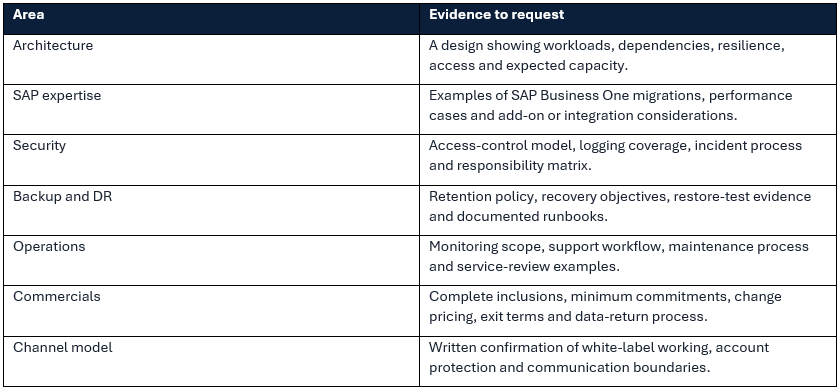
A practical hosting-provider evaluation checklist
 When is a specialist partner platform the better choice?
A specialist platform becomes particularly valuable when a partner wants to move multiple customers to cloud, standardise delivery or create a managed-service proposition without building a 24/7 infrastructure operation. It can also reduce key-person dependency by replacing informal knowledge with documented processes, monitoring and repeatable deployment patterns.
Cloud4Partners offers SAP Business One hosting on AWS, including dedicated and other deployment options, partner support and a structured Migration Factory. The value is not merely access to AWS; it is the combination of a partner-only commercial model, SAP Business One focus and an operational platform designed to be delivered through the channel.
Further Reading:
How to Migrate SAP Business One Customers to the Cloud without the Headaches
Why More SAP Business One Partners are Moving Customers to the Cloud
Why SAP Business One Partners are Outsourcing Infrastructure Management
Frequently asked questions
Is SAP Business One hosting the same as putting a server in a data centre?
No. Traditional hosting may relocate fixed infrastructure without providing cloud automation, modern resilience or active management. Partners should evaluate architecture, operations, security and recovery rather than accepting the cloud label at face value.
Should every SAP Business One customer use the same hosting architecture?
No. User numbers, database platform, add-ons, integrations, performance profile, geography and compliance requirements can justify different deployment patterns. Standardisation is valuable, but it should include controlled options rather than force every customer into an unsuitable design.
What uptime should an SAP Business One hosting provider offer?
The percentage should be commercially meaningful and supported by an architecture capable of delivering it. Partners should examine measurement scope, exclusions, service credits and the recovery arrangements behind the figure, not simply choose the largest number.
Who supports the customer when infrastructure is white-labelled?
The SAP partner normally remains the primary customer contact while the hosting provider works behind the scenes as an extension of the partner’s team. Responsibilities, escalation routes and communication rules should be documented before go-live.
How difficult is it to move an existing SAP Business One customer to a new provider?
The complexity depends on database size, add-ons, integrations, connectivity, user access and the current provider’s exit process. A structured discovery, test migration, validation plan and rollback method can make the move controlled and predictable.
Build a hosting proposition your customers can trust
The best hosting decision is the one that protects customer experience while giving the partner room to grow. Review architecture, operations, commercial alignment and channel behaviour together. To benchmark your current service or discuss a partner-only AWS platform for SAP Business One, speak with Cloud4Partners about your estate and growth plan.